Quantum Computing · Tool Development · 2026
Toolkit for Quantum Networking Research
Role: Consultant · With: Dr. Russell Ceballos, Chicago State University · Status: Complete
Dr. Ceballos had two weeks to draft a conference paper on optimizing Bell state measurement angles across quantum networks. His group’s simulation work was spread across several people’s machines, with no shared setup and no consistent way to compare results.
I built a single toolkit on SeQUeNCe that hides the simulator’s plumbing, so researchers describe a network the way they would in the lab: distances in kilometers, angles in degrees, realistic noise. I checked the code myself so the results can be trusted. Building it taught me enough about the problem to help shape the paper and to set the group up for follow-up questions. What happens when an eavesdropper is listening? How do the results change if you track the photons’ full quantum state through the network?
The paper went out on time. Two students used the toolkit for the research, three more are using it to prepare for an upcoming conference, and the group now uses it to introduce undergraduates to quantum networking.
"One or two sentences from the client about what changed for them. Optional; delete this quote if there isn't one."
— Dr. Russell R. Ceballos, Director, Quantum Innovation and Research Center
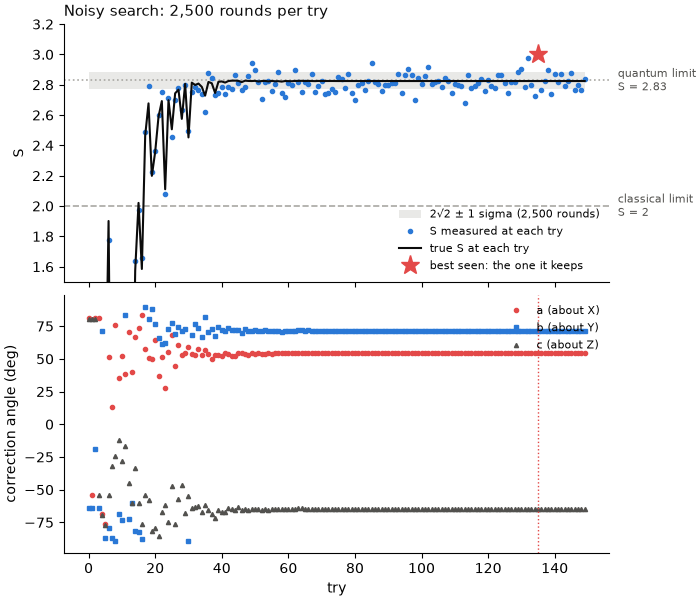
Optimizing measurement angles on a noisy simulated link. The Bell-test score climbs past the classical limit (2) within about 30 tries and settles near the quantum limit (2√2), as the three angles converge below.
Machine Learning · Patent & Methods Review · 2025
The Math Behind a Time-Series Prediction System
Role: Advisor · With: CCMC Advanced Technologies · Status: Complete
CCMC built a general-purpose system for predicting dynamical systems using reservoir computing. They had working prototypes and patent applications in progress, and those patents would support government contracts and fundraising. What they needed was an independent check that the math held up: that the patent claims were consistent and correct, and that the code behaved the way the claims said it would.
I reviewed the patent applications for mathematical correctness and tightened the language so the claims said exactly what the team meant. Alongside the review, I helped write and validate the prediction code, including the regularization that keeps a reservoir computer from fitting noise instead of the underlying dynamics.
"His work helped strengthen our international patent pathway and played an important role in advancing our government partnerships and procurement positioning."
— Mario I. Tovar, Jr., Co-Founder and CEO, CCMC Advanced Technologies Inc.
A reservoir computer trained on a short window (shaded) keeps the predator–prey system's conserved quantity nearly constant over the full run, while even an 8th order solver drifts away eventually
Quantum Computing · Teaching · 2021–2023
Math for a Career Change into Quantum Computing
Role: Teacher · With: Amir Ebrahimi · Status: Graduated
Amir went back to school for an MS in CS focused on quantum computing after years as a software engineer. The coursework leaned on linear algebra and probability he hadn't used since his undergraduate degree, and the rigorous quantum material was new to him.
We met regularly throughout the degree. I answered his quantum computing questions as they came up and rebuilt the math underneath them, so he could follow the reasoning in his courses, not just get through the homework. When he chose the thesis track, I helped him navigate it and reviewed drafts for clarity and accuracy. During his MS, he was hired as a Staff Quantum Software Engineer at Photonic Inc., and we still work together.
"I transitioned careers almost 20 years after getting my bachelor's in Computer Science, resulting in me going back for my master's. I needed support specifically in higher-level mathematics, where Harrison excels."
— Amir Ebrahimi, Staff Quantum Software Engineer, Photonic Inc.